Modern applications often run in cloud environments where scalability, portability, and efficiency are important. Two popular technologies used to run applications in isolated environments are Virtual Machines (VMs) and Containers. While both help developers deploy software reliably, they work in different ways and are suited for different use cases.
This article explains the differences and when to use each.
What Is a Virtual Machine?
A Virtual Machine (VM) is a software-based computer that runs inside a physical computer. Each VM includes:
- A full operating system (OS)
- Virtual hardware (CPU, memory, storage)
- Applications
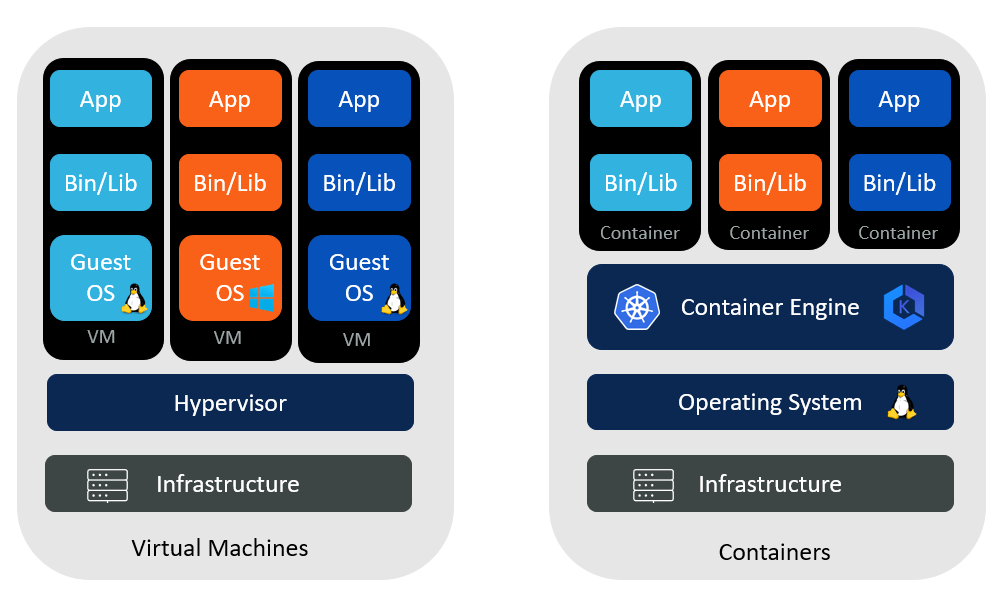
VMs run on top of a hypervisor, which manages multiple virtual machines on a single physical machine. Popular virtualization platforms include VMware and Microsoft Hyper-V.
How Virtual Machines Work
- A physical server hosts a hypervisor.
- The hypervisor creates multiple virtual machines.
- Each VM runs its own operating system independently.
This means one physical computer can run several different systems at the same time.
Key Characteristics of Virtual Machines
- Full OS for each VM
- Strong isolation between environments
- Higher resource usage
- Slower startup time compared to containers
What Are Containers?
Containers are lightweight environments that package an application together with everything it needs to run, such as:
- Libraries
- Dependencies
- Runtime
Unlike virtual machines, containers share the host operating system kernel, which makes them much more efficient.
Container technology became widely popular through platforms like Docker and orchestration tools like Kubernetes.
How Containers Work
- The host machine runs a single operating system.
- Containers run on top of the OS using container engines.
- Each container isolates the application and its dependencies.
This allows applications to run consistently across different environments.
Key Characteristics of Containers
- Lightweight and fast
- Share the host OS
- Efficient resource usage
- Easy to scale and deploy
Virtual Machines vs Containers: Key Differences
| Feature | Virtual Machines | Containers |
|---|---|---|
| Operating System | Each VM has its own OS | Share host OS |
| Resource Usage | Higher | Lower |
| Startup Time | Slower | Very fast |
| Isolation | Strong isolation | Process-level isolation |
| Size | Larger (GBs) | Smaller (MBs) |
| Deployment Speed | Slower | Faster |
When to Use Virtual Machines
Virtual machines are best when strong isolation and full system control are required.
1. Running Multiple Operating Systems
VMs are useful when different OS environments are needed.
Examples:
- Running Windows and Linux on the same server
- Testing software on multiple operating systems
2. Legacy Applications
Some older applications require specific operating systems or configurations that work best in VMs.
3. Security and Isolation
VMs provide stronger separation between environments, making them useful for:
- Secure workloads
- Enterprise systems
- Sensitive applications
4. Infrastructure Virtualization
Organizations often use VMs to create virtual data centers and manage servers efficiently.
When to Use Containers
Containers are best for modern, scalable applications and fast deployment.
1. Microservices Architecture
Applications built as microservices benefit from containers because each service can run independently.
Examples:
- Cloud applications
- SaaS platforms
- APIs
2. Continuous Integration and Deployment (CI/CD)
Containers allow developers to build, test, and deploy applications quickly and consistently.
3. Cloud-Native Applications
Containers are widely used in cloud platforms because they scale easily.
4. Faster Development and Testing
Developers can quickly create identical environments across development, testing, and production.
Real-World Example
Imagine a company building a large web platform.
Using Virtual Machines:
- Each service runs on a separate VM.
- More resources are used.
- Setup and scaling take longer.
Using Containers:
- Each service runs in its own container.
- Faster deployment and scaling.
- More efficient use of resources.
This is why many modern tech companies use containers for large-scale systems.
Can Virtual Machines and Containers Work Together?
Yes. In many real-world environments:
- Containers run inside virtual machines.
- VMs provide infrastructure and security.
- Containers handle application deployment.
This combination is common in cloud platforms and enterprise systems.
Conclusion
Virtual Machines and Containers both help run applications in isolated environments, but they serve different purposes. Virtual machines provide full system virtualization and strong isolation, while containers offer lightweight, fast, and scalable application deployment.
In modern development, containers are becoming more popular for cloud-native applications, while virtual machines remain important for infrastructure, legacy systems, and secure workloads. Understanding both technologies helps developers choose the right tool for their projects.