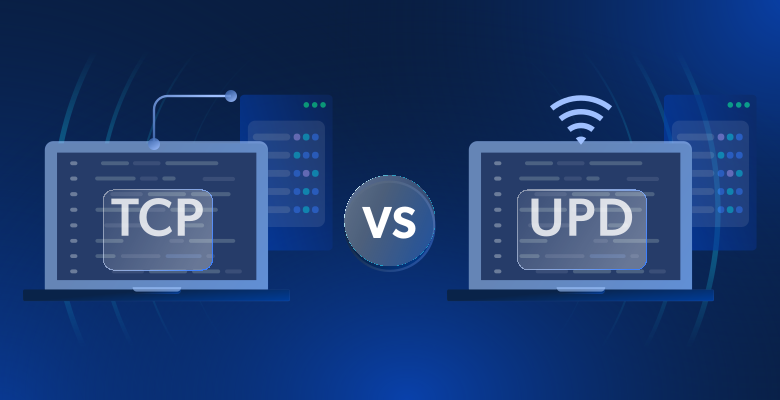
When computers communicate over the internet or a network, they rely on protocols to send and receive data. Two of the most important transport layer protocols are TCP (Transmission Control Protocol) and UDP (User Datagram Protocol). Both move data between devices, but they are designed for different purposes. Understanding their use cases helps explain why certain apps work the way they do.
What is TCP?
TCP is a connection-oriented protocol. This means a connection is established between the sender and receiver before any data is sent. TCP ensures that data arrives:
- In the correct order
- Without errors
- Without missing pieces
It uses acknowledgments, retransmissions, and flow control to guarantee reliable delivery.
Key Characteristics
- Reliable data transfer
- Error checking and correction
- Ordered delivery
- Slower compared to UDP because of extra checks
Common TCP Use Cases
- Web Browsing (HTTP/HTTPS)
Websites need accurate data transfer. If a webpage loads incorrectly or missing elements, the experience breaks. TCP ensures the full page arrives correctly. - Email Services (SMTP, IMAP, POP3)
Emails must be delivered completely and accurately, including attachments and formatting. - File Transfers (FTP, SFTP)
When downloading or uploading files, reliability is critical. TCP guarantees that the entire file is received correctly. - Database Communication
Applications connecting to databases rely on TCP to ensure queries and responses are accurate. - Online Transactions
Banking systems, e-commerce platforms, and payment systems use TCP because data integrity is essential.
What is UDP?
UDP is a connectionless protocol. It sends data without establishing a connection and does not check whether packets arrive correctly or in order.
This makes UDP much faster and more efficient, but less reliable.
Key Characteristics
- Faster data transmission
- No connection setup
- No guaranteed delivery
- Lower latency
Common UDP Use Cases
- Online Gaming
Multiplayer games require fast updates. It’s better to receive the latest player position quickly than to wait for missing packets. - Live Video Streaming
Platforms that stream live events prioritize speed over perfect delivery. A small data loss is usually unnoticeable to viewers. - Voice Calls (VoIP)
Real-time communication apps like voice and video calls need low latency. Delayed audio is worse than minor packet loss. - DNS (Domain Name System)
DNS queries must be quick. If a response is lost, the request can simply be sent again. - IoT Devices and Sensors
Many small devices send frequent, lightweight data where speed and efficiency matter more than guaranteed delivery.
TCP vs UDP: Quick Comparison
| Feature | TCP | UDP |
|---|---|---|
| Connection | Connection-oriented | Connectionless |
| Reliability | High | Low |
| Speed | Slower | Faster |
| Error Checking | Yes | Minimal |
| Data Order | Guaranteed | Not guaranteed |
| Best For | Accuracy and reliability | Real-time communication |
When to Choose TCP or UDP
- Choose TCP when data accuracy and reliability are more important than speed.
- Choose UDP when speed, real-time communication, and low latency are more important than perfect delivery.
In modern networking, many applications combine both approaches—using TCP for critical data and UDP for real-time interactions.