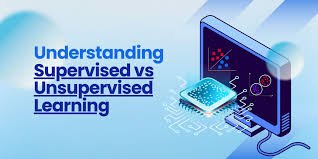
Machine learning is a key part of modern technology, powering recommendation systems, fraud detection, image recognition, and more. Two of the most fundamental approaches in machine learning are supervised learning and unsupervised learning. Understanding the difference between them helps explain how intelligent systems learn from data.
What Is Supervised Learning?
Supervised learning is a type of machine learning where the model is trained using labeled data. This means the dataset already contains the correct answers, and the algorithm learns by comparing its predictions to those answers.
In simple terms, the model learns from examples where both the input and the expected output are known.
How It Works
- A dataset with labeled examples is provided.
- The model studies patterns between input and output.
- It learns to predict the correct output for new, unseen data.
Example:
If you train a model to detect spam emails, the training data might include:
- Email content (input)
- Label: spam or not spam (output)
Over time, the model learns patterns that indicate spam.
Common Supervised Learning Tasks
1. Classification
The model predicts categories.
Examples:
- Spam detection
- Disease diagnosis
- Image recognition (cat vs dog)
2. Regression
The model predicts continuous values.
Examples:
- House price prediction
- Sales forecasting
- Weather prediction
Real-World Use Cases
Supervised learning is widely used in:
- Fraud detection systems
- Credit scoring
- Speech recognition
- Recommendation systems
- Medical diagnosis tools
What Is Unsupervised Learning?
Unsupervised learning works with unlabeled data. The algorithm is not given the correct answers. Instead, it tries to discover patterns, structures, or relationships in the data on its own.
The goal is to explore the data and find hidden insights.
How It Works
- A dataset without labels is provided.
- The algorithm analyzes similarities and patterns.
- It groups or organizes the data based on structure.
Example:
A business might analyze customer behavior without predefined categories to discover new customer segments.
Common Unsupervised Learning Tasks
1. Clustering
Grouping similar data points together.
Examples:
- Customer segmentation
- Social network analysis
- Market research
2. Association
Finding relationships between variables.
Example:
Market basket analysis (items frequently bought together).
3. Dimensionality Reduction
Simplifying large datasets while keeping important information.
Examples:
- Data visualization
- Noise reduction
- Feature extraction
Real-World Use Cases
Unsupervised learning is used in:
- Customer segmentation
- Recommendation engines
- Anomaly detection
- Data exploration
- Pattern discovery in large datasets
Supervised vs Unsupervised Learning: Key Differences
| Feature | Supervised Learning | Unsupervised Learning |
|---|---|---|
| Data Type | Labeled data | Unlabeled data |
| Goal | Predict outcomes | Discover patterns |
| Training Guidance | Has correct answers | No predefined answers |
| Complexity | Easier to evaluate | Harder to interpret |
| Common Tasks | Classification, Regression | Clustering, Association |
Example to Understand the Difference
Imagine a dataset of photos of animals.
Supervised learning:
The dataset already includes labels like:
- Cat
- Dog
- Bird
The model learns to classify new images correctly.
Unsupervised learning:
The dataset has no labels.
The algorithm groups images based on similarities such as:
- Shape
- Color
- Texture
Later, humans might interpret those groups.
When to Use Each Approach
Use supervised learning when:
- You have labeled data
- You need predictions
- Accuracy is critical
- The problem is clearly defined
Use unsupervised learning when:
- Data has no labels
- You want to explore patterns
- You’re analyzing large datasets
- You’re discovering hidden insights
Modern Machine Learning Often Combines Both
In real-world systems, companies often combine supervised and unsupervised learning to build better models. For example:
- Unsupervised learning finds patterns in data.
- Supervised learning uses those patterns to make predictions.
This combination helps improve accuracy and discover deeper insights from data.