
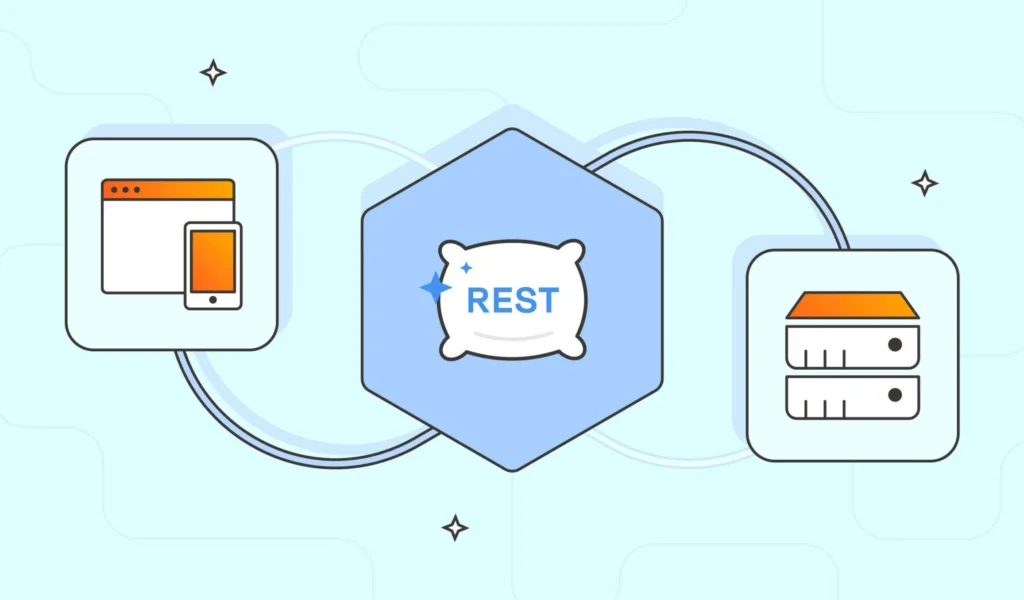
Modern apps rarely work alone. Most applications you use every day—mobile apps, websites, and cloud platforms—communicate with servers and other services through REST APIs. REST APIs are the backbone that allows different systems to exchange data over the internet.
This article explains how REST APIs work in real applications, step by step.
What Is a REST API?
A REST API (Representational State Transfer Application Programming Interface) is a way for applications to communicate using standard web protocols, usually over HTTP.
In simple terms:
- A client (such as a mobile app or website) sends a request.
- A server processes the request.
- The server returns a response, usually in JSON format.
REST APIs make it easy for different systems to interact regardless of the programming language or platform used.
Basic Components of a REST API
1. Client
The client is the application that sends requests to the server.
Examples:
- A mobile app
- A website frontend
- Another backend service
For example, when you open a feed on Instagram, the app sends API requests to fetch posts and user data.
2. Server
The server hosts the API and processes requests. It contains:
- Business logic
- Databases
- Authentication systems
The server decides what data to send back to the client.
3. Resources
In REST, everything is treated as a resource. A resource could be:
- Users
- Products
- Messages
- Orders
Each resource is accessed using a URL (endpoint).
Example:
/users
/products
/orders
How REST APIs Work (Step-by-Step in Real Apps)
Step 1: A User Performs an Action
A user opens an app or clicks something.
Example:
- You open a profile in Facebook.
- The app needs to load profile information.
Step 2: The Client Sends an HTTP Request
The app sends a request to the server using an HTTP method.
Common HTTP methods:
- GET – Retrieve data
- POST – Create data
- PUT/PATCH – Update data
- DELETE – Remove data
Example request:
GET /api/users/123
This means: “Get user with ID 123.”
Step 3: The Server Processes the Request
The server:
- Authenticates the user
- Checks permissions
- Fetches data from the database
- Formats the response
This usually happens within milliseconds.
Step 4: The Server Sends a Response
The server sends back data, often in JSON format.
Example response:
{
  "id": 123,
  "name": "Alex",
  "followers": 2450
}
The app then displays the information to the user.
Example: REST API in an E-Commerce App
Let’s see how REST APIs work in a real shopping app like Amazon.
Viewing Products
Request:
GET /api/products
Response:
List of available products.
Adding an Item to Cart
Request:
POST /api/cart
Response:
Confirmation that the item was added.
Placing an Order
Request:
POST /api/orders
Response:
Order details and confirmation.
All of these actions happen through API calls between the app and the server.
Why REST APIs Are Popular in Real Applications
1. Scalability
REST APIs work well for applications that serve millions of users.
2. Platform Independence
Apps built with different technologies can communicate easily.
Example:
- Mobile apps
- Web apps
- Cloud services
3. Simplicity
REST uses standard HTTP methods that developers already understand.
4. Flexibility
Multiple clients can use the same API.
Example:
- Mobile app
- Website
- Third-party integrations
REST APIs in Modern Tech Systems
Today, REST APIs power many major services including:
- Social media platforms
- Payment systems
- Cloud services
- Streaming platforms
Companies like Netflix use APIs to deliver content, manage accounts, and handle recommendations.
Challenges in Real Applications
Even though REST APIs are powerful, real systems must handle challenges such as:
- Security and authentication
- Rate limiting
- Large traffic loads
- API versioning
- Data consistency
Developers often use:
- API gateways
- Caching
- Load balancing
- Token-based authentication (like JWT)
Conclusion
REST APIs are essential in modern software development. They allow applications to communicate, share data, and scale across platforms. Whether you’re browsing social media, shopping online, or streaming videos, REST APIs are working behind the scenes to make everything function smoothly.
Understanding how REST APIs work helps developers build scalable and efficient real-world applications.