Programming paradigms are different ways of organizing and structuring code. Two of the most widely used paradigms in modern software development are Object-Oriented Programming (OOP) and Functional Programming (FP). Each approach solves problems differently and is suited to different types of applications.
This article explains how they work and when to use each.
What Is Object-Oriented Programming (OOP)?
Object-Oriented Programming is a paradigm based on the concept of objects, which represent real-world entities. An object contains:
- Data (attributes or properties)
- Functions (methods or behaviors)
OOP focuses on modeling software around objects that interact with each other.
Core Principles of OOP
1. Encapsulation
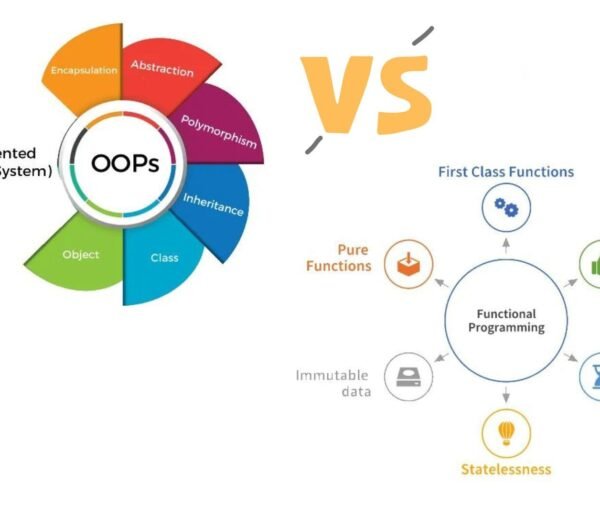
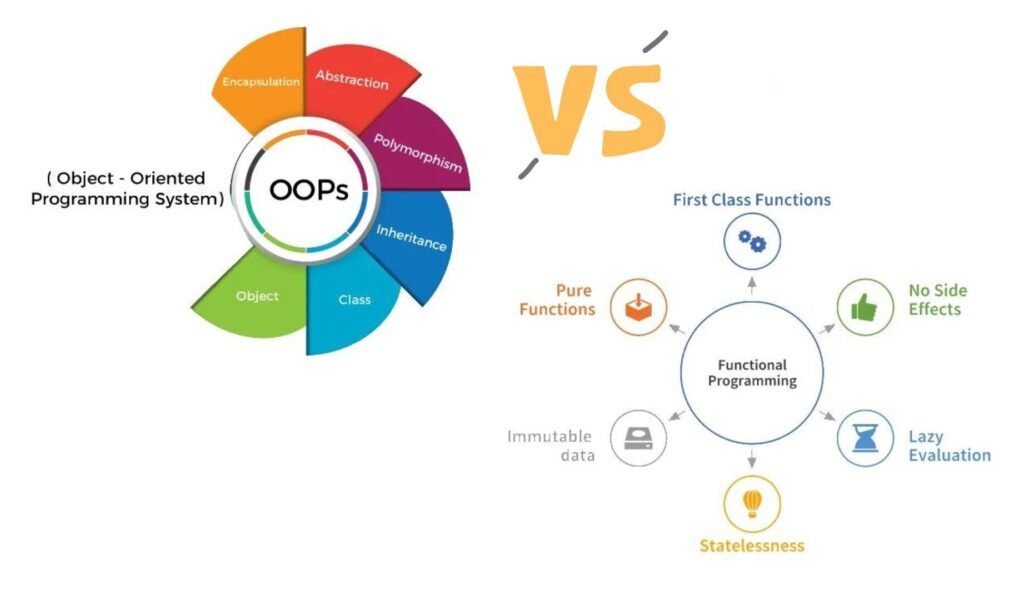
Data and methods are bundled together in a class, and internal details are hidden from the outside.
2. Inheritance
A class can inherit properties and behaviors from another class, allowing code reuse.
3. Polymorphism
Different objects can use the same method name but behave differently.
4. Abstraction
Complex implementation details are hidden, showing only essential features.
Example Concept
In an e-commerce application:
UserobjectProductobjectOrderobject
Each object contains data and functions relevant to it.
Example:
class Product {
  name
  price
  updatePrice()
}
Common Use Cases for OOP
OOP is best suited for systems with complex structures and relationships.
Examples:
- Large enterprise applications
- Game development
- Desktop software
- Banking systems
- Mobile applications
OOP is widely used because it mirrors real-world modeling and is easier to scale in large projects.
What Is Functional Programming (FP)?
Functional Programming is a paradigm that treats computation as the evaluation of functions. Instead of focusing on objects and state changes, FP focuses on:
- Pure functions
- Immutability
- Data transformation
In functional programming, functions are the primary building blocks of programs.
Key Concepts of Functional Programming
1. Pure Functions
A pure function always produces the same output for the same input and has no side effects.
Example:
add(a, b) = a + b
2. Immutability
Data is not modified after it is created. Instead, new data structures are produced.
3. First-Class Functions
Functions can be:
- Stored in variables
- Passed as arguments
- Returned from other functions
4. Function Composition
Small functions can be combined to build more complex logic.
Example Concept
Instead of modifying an object, functional programming transforms data.
Example:
newPrice = applyDiscount(price)
Key Differences Between OOP and Functional Programming
| Feature | Object-Oriented Programming | Functional Programming |
|---|---|---|
| Main Focus | Objects and classes | Functions and data transformation |
| Data Handling | Mutable objects | Immutable data |
| Code Structure | Organized around entities | Organized around functions |
| State Management | Changes state over time | Avoids changing state |
| Complexity Handling | Good for modeling real systems | Good for mathematical and data-heavy tasks |
When to Use Object-Oriented Programming
Use OOP when:
- Building large applications with many interacting components
- Modeling real-world systems
- Managing complex state and relationships
- Developing long-term scalable software systems
Examples:
- Banking software
- Inventory management systems
- Large web applications
- Game engines
OOP helps organize large codebases and makes maintenance easier.
When to Use Functional Programming
Use Functional Programming when:
- Working with data transformations
- Handling concurrent or parallel processing
- Building scalable backend systems
- Reducing bugs caused by shared state
Examples:
- Data processing pipelines
- Financial calculations
- Distributed systems
- Real-time analytics
Functional programming reduces side effects and makes code more predictable.
Real-World Development Uses Both
In modern software development, many languages and frameworks combine both paradigms. Developers often:
- Use OOP for application structure
- Use functional programming for data processing and logic
For example:
- Backend services may use OOP architecture
- Data operations may use functional patterns
This hybrid approach improves flexibility and code quality.
Conclusion
Object-Oriented Programming and Functional Programming are two powerful approaches to building software. OOP focuses on modeling systems through objects and relationships, while Functional Programming emphasizes pure functions and data transformation.
Understanding both paradigms allows developers to choose the right approach depending on the problem they are solving—and often, the best solutions combine elements of both.