
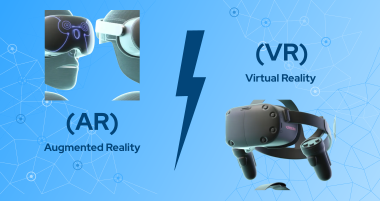
Augmented Reality (AR) and Virtual Reality (VR) are two immersive technologies that are often mentioned together, but they are not the same. While both enhance how we experience digital content, they do so in very different ways. Understanding the difference between AR and VR helps explain how these technologies are used in gaming, education, healthcare, and many other fields.
What Is Augmented Reality (AR)?
Augmented Reality (AR) adds digital elements to the real world. Instead of replacing your surroundings, AR enhances them by overlaying images, text, or animations onto what you see in real time.
Examples of AR
- Pokémon GO
- Instagram and Snapchat filters
- Google Maps live navigation
- Virtual furniture placement apps
AR typically works through smartphones, tablets, or AR glasses.
What Is Virtual Reality (VR)?
Virtual Reality (VR) creates a fully immersive digital environment. When using VR, the real world is completely blocked out and replaced with a computer-generated world.
Examples of VR
- VR gaming (Meta Quest, PlayStation VR)
- Virtual training simulations
- Virtual tours and experiences
- Medical and flight simulators
VR usually requires a headset and sometimes additional controllers or sensors.
Key Differences Between AR and VR
| Feature | Augmented Reality (AR) | Virtual Reality (VR) |
|---|---|---|
| Environment | Enhances the real world | Replaces the real world |
| Immersion Level | Partial | Full |
| Hardware | Smartphone, tablet, AR glasses | VR headset and controllers |
| User Interaction | With real and digital objects | Only digital objects |
| Use Cases | Navigation, retail, education | Gaming, training, simulations |
How AR and VR Are Used Today
Uses of AR
- Retail: Try products before buying
- Education: Interactive learning content
- Healthcare: Surgical assistance and visualization
- Manufacturing: Maintenance guidance
Uses of VR
- Gaming and entertainment
- Employee training and safety simulations
- Therapy and mental health treatment
- Architecture and design walkthroughs
Advantages and Limitations
Advantages of AR
- Easy to access using smartphones
- Enhances daily tasks
- Safer since users remain aware of surroundings
Limitations of AR
- Less immersive than VR
- Dependent on device performance
Advantages of VR
- Highly immersive experiences
- Ideal for simulations and training
- Strong sense of presence
Limitations of VR
- Requires specialized hardware
- Can cause motion sickness
- Isolates users from the real world
Which One Is Better?
Neither AR nor VR is “better” — they serve different purposes.
- Choose AR when you want to enhance the real world.
- Choose VR when you want to experience a completely virtual environment.
In some cases, both technologies are combined into Mixed Reality (MR) for even richer experiences.
The Future of AR and VR
AR and VR are evolving rapidly with advancements in AI, 5G, and wearable devices. As hardware becomes lighter and more affordable, these technologies are expected to become more common in workplaces, classrooms, and everyday life.
Conclusion
AR and VR are powerful technologies shaping the future of digital interaction. While AR blends digital elements with the real world, VR immerses users in a completely virtual environment. Understanding their differences helps individuals and businesses choose the right technology for their needs.